Getting started
The things worth knowing before anything else on this site is much use: what the pieces are worth, how to open a game, how to write your moves down, and the two rules everybody finds surprising.
How to get better
The best way to learn how to play chess is with someone who can explain the rules and help you improve. Use algebraic notation to write down your games and go over each game to see how you could do better next time, and not to carry on making the same mistakes.
When learning openings, make sure you know what moves are right or wrong. Solve puzzles on a regular basis to hone your tactical awareness.
Study the endgame, and learn mating patterns with queen, rooks, knights and bishops.
Be passionate about winning every game and becoming a stronger player.
Chess is worth the effort for reasons that go well beyond the board. It builds concentration, problem solving, logic, mathematical thinking, creativity, patience, memory and self control — and it is a game you can play for the rest of your life.
What the pieces are worth
Here is the standard valuation of the pieces. It is a rough guide for deciding whether a trade is good for you.
| Piece | Value |
|---|---|
| King | Not assigned |
| Queen | 9 |
| Rook | 5 |
| Bishop | 3 |
| Knight | 3 |
| Pawn | 1 |
Sometimes the values are not a proper indication — it is determined by the conditions of the game. The fighting worth of the king is around four points in the endgame, when checkmate is not a serious threat. The king excels at assaulting and defending pieces and pawns that are close by, and is superior to the knight and the bishop at both.
Also, three minor pieces (9 points) are often somewhat stronger than two rooks (10 points) or a queen (9 points).
The A B C D of chess
Four simple rules to improve your chess, and they spell out A B C D. Each one is shown on the same game, a few moves further on than the last.
A — Activate your central pawns
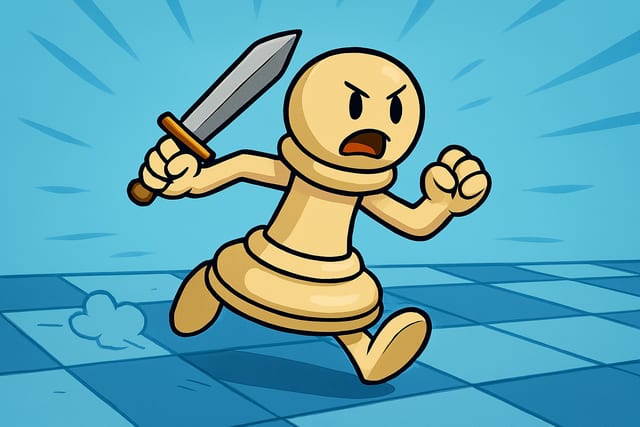
“Activate and accelerate your central pawns. By pushing these pawns forward you control the all-important centre and help to free your bishops.”
Avoid pushing flank pawns — the a, b, g and h files — which let your opponent control the middle of the board.
B — Bishops and knights out early
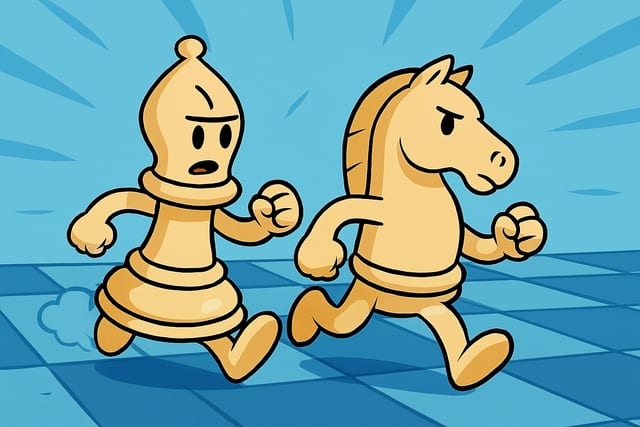
“Bishops and knights need to be deployed as quickly as possible. Avoid moving the same piece twice until you are ready to attack.”
Knights perform best in central areas, not on the edges.
C — Castle early
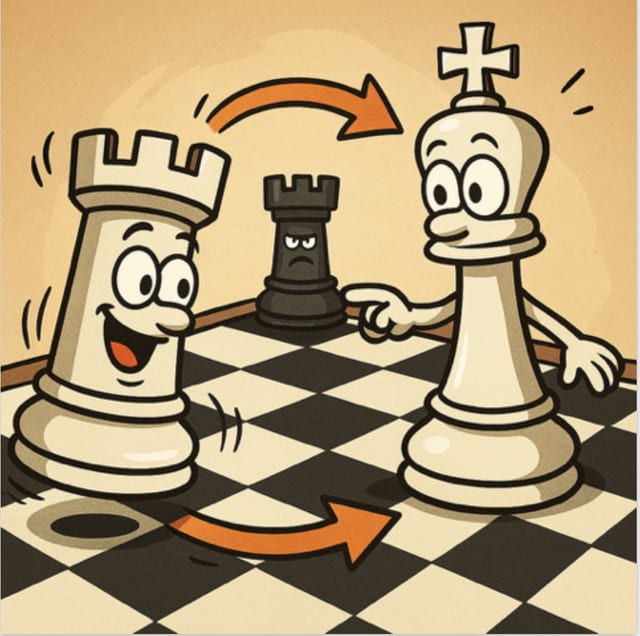
“Castle early and get the king safe. This also allows the king’s rook to get into the game quickly.”
Keep pawns close to the king without pushing them hastily and leaving it exposed. There is more about castling further down this page.
D — Develop and connect your rooks
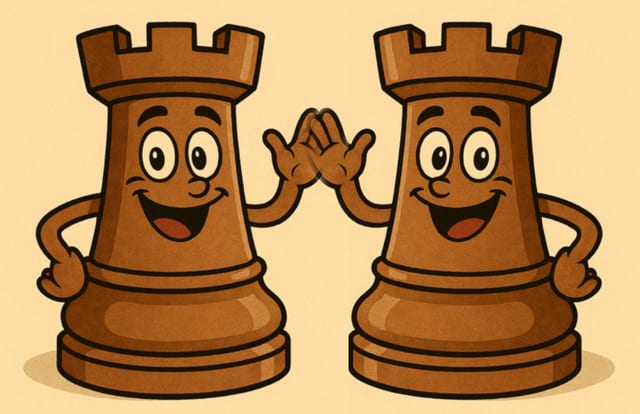
“Develop your rooks so they are connected, and place them on open or semi-open files if possible. Connected rooks are happy people!”
“Rooks on open files are rooks with smiles!”
Then wait patiently for your opponent to make a mistake, rather than always attacking first. A lot of chess skill is recognising an error and taking advantage of it.
Ten rules for the opening
Many games between beginners are lost by not sticking to these ten rules. An experienced player will be aware of many exceptions.
- Put your pawns in the centre, opening with either the d-pawn or the e-pawn.
- Make a good developing move that threatens something wherever possible.
- Play the obvious before the optional — you will often know where a knight should go, while the bishop has more good squares to choose from.
- Pick the most suitable square for a piece, aiming to coordinate your pieces, and develop it there once and for all.
- Don’t move one piece twice before moving others once.
- Only make one or two pawn moves in the opening — without quick development you will lose the initiative.
- Don’t bring your queen out too early.
- Castle early-ish, preferably on the kingside. Castling brings your king to safety and develops your rooks.
- Play to get control of the centre and always try to maintain at least one pawn there.
- Never sacrifice without a clear and adequate reason.
There is more to it than ten rules. You will need a good understanding of these to get consistently into a decent middle game against strong players:
- Coordinating your pieces
- Control of the centre
- Space
- Pawn structures
On pawn structures, for instance: aim to avoid isolated pawns, to have as few pawn islands as possible, and remember that the direction in which the fixed pawns lean will almost certainly be the flank on which to concentrate your resources.
Writing your moves down
The art of playing good chess is to study the board, consider options, devise strategy and anticipate your opponent’s next moves. This cannot be done in a nanosecond, which is how most youngsters seem to play, ending up quickly losing material and consequently the game.
In an attempt to slow some of you down and take you to the next level in chess, we need to teach you how to record your game, using notation.
Should you enter a competition, other than blitz or rapidplay with their short timings, you will be required to record your game this way.
Notation sheets and pens will be available for those who want to give this a try. We recommend all advanced players in our groups to learn it.
Chess notation was developed in order to record the position of the pieces on the chessboard, or the moves being made during a game. This is done by indicating the current piece and square location, and where the piece is being moved to. It also enables us to review games played by grandmasters and other chess players, and your own games too, so you can go back over them and learn. Learning chess notation is a must if you want to study games and problems from any kind of chess book.
Every square has a name
One of the most important things to do if you want to become a stronger player is to record your games and analyse them. The way we do this is called algebraic notation. It is very simple, and used by chess players all over the world.
Each of the 64 squares has a unique label made of a letter and a number. The letter is the file, read across the board from a to h; the number is the rank, counted up the board from 1 to 8. At the start of a game White’s pieces are on ranks 1 and 2, and Black’s on ranks 7 and 8.
| a | b | c | d | e | f | g | h | |
|---|---|---|---|---|---|---|---|---|
| 8 | a8 | b8 | c8 | d8 | e8 | f8 | g8 | h8 |
| 7 | a7 | b7 | c7 | d7 | e7 | f7 | g7 | h7 |
| 6 | a6 | b6 | c6 | d6 | e6 | f6 | g6 | h6 |
| 5 | a5 | b5 | c5 | d5 | e5 | f5 | g5 | h5 |
| 4 | a4 | b4 | c4 | d4 | e4 | f4 | g4 | h4 |
| 3 | a3 | b3 | c3 | d3 | e3 | f3 | g3 | h3 |
| 2 | a2 | b2 | c2 | d2 | e2 | f2 | g2 | h2 |
| 1 | a1 | b1 | c1 | d1 | e1 | f1 | g1 | h1 |
The symbols
A pawn is given no symbol. The pieces have one each:
- King = K
- Queen = Q
- Rook = R
- Bishop = B
- Knight = N
There are symbols for the special moves too:
- Castling kingside = 0-0
- Castling queenside = 0-0-0
- Check = +
- Double check = ++
- Checkmate = #
- En passant = e.p.
- Captures = x
A move is written by giving:
- the move number in the game
- the symbol of the piece
- the square it moves from, if that is not obvious
- the square it moves to
- an x before the final square if it captures something
1. e4  e5  2. Nf3  Nc6  3. Bc4  Nf6  4. Qe2  Bc5  5. O-O  O-O
6. d3  Re8  7. Bg5  h6
Writing your own games down is how you get better at reading them back. The club uses a printed score sheet for it: a grid with room for the event, the date and each player’s name, then fifty numbered rows in two columns — one for White’s move and one for Black’s — and a line at the foot to tick who won.
Download the score sheet as a PDF, print it, and bring it along on Saturday to write a game down as you play it.
Castling
Castling is a special move where you do several unique things at once. First, it is the only move where you may move two pieces in the same move. Second, it is the only time in chess when it is legal to move the king more than one square. Third, it is the only move that both develops your rook and protects your king.
Castling can be performed on the kingside, written 0-0, or the queenside, written 0-0-0.
It is permitted only if neither the king nor the rook has previously moved, and the squares between them are vacant. The king must also not leave, cross over, or finish on a square attacked by an enemy piece.
Quiz time on castling
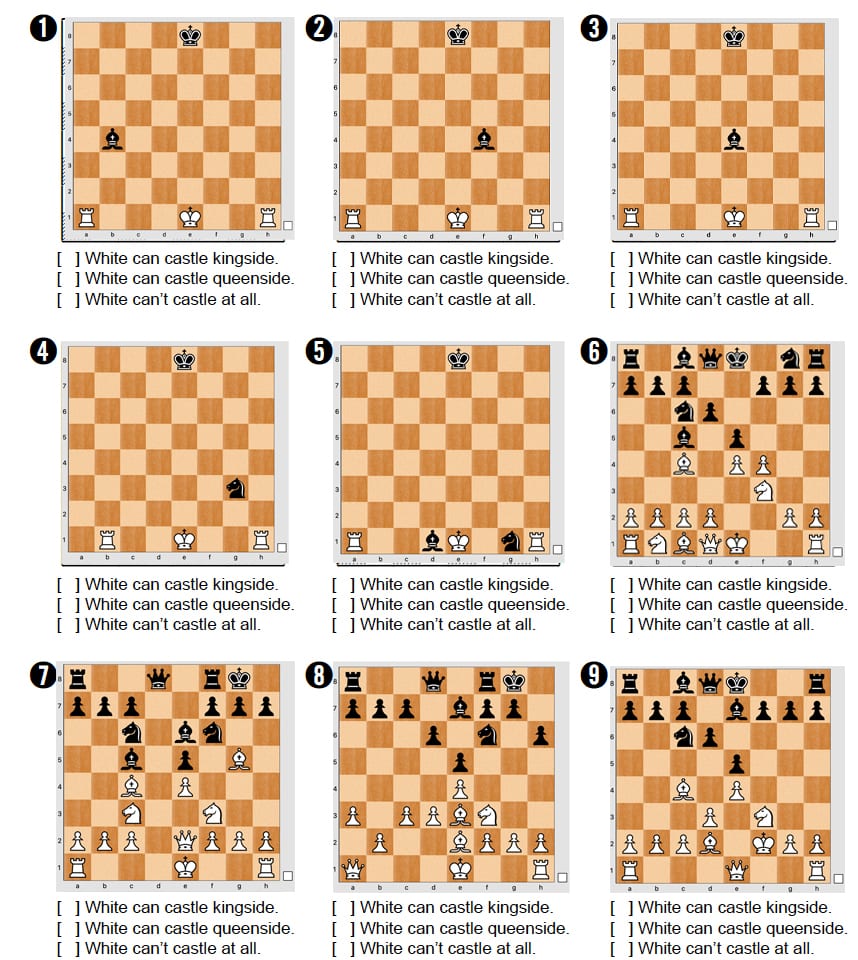
Get all nine correct for 3 points, six correct for 2 points, and three correct for 1 point. See how many points you score.
In each of these pictures it is White’s turn to move. You have to decide whether White is allowed to castle on the kingside, on the queenside, or not at all. Assume that a piece on its starting square has not moved yet.
Once you have decided, tick the correct box or boxes below the picture. If White is not allowed to castle on one or both sides, write the reason on the picture too.
Download the quiz as a PDF, print it, fill it in, and bring it along on Saturday or email it to graham7morris@gmail.com.
En passant
This rule concerns the double-square move of the pawn. En passant is French for ‘in passing’. Some students have trouble understanding when this strange move can be played, so here is an attempt to clarify it.
Suppose you are White and you have a pawn on your fifth rank. In front of it are some black pawns on their starting squares. It is Black to move, and Black can move either of the two outside pawns two squares; the middle pawn can only move one, because your pawn is in its way.
If Black moves one of the outside pawns two squares, bringing it alongside your pawn, then you can capture en passant.
1… c5 2. dxc6
Here is the same thing the other way round, with Black doing the capturing.
1. d4 cxd3
You do not have to capture en passant if you do not want to. You could move your pawn forward instead, or move another piece entirely.
The rules of en passant
- The taking pawn has to be on its fifth rank.
- The pawn to be taken has to have moved two squares forward on its first move.
- The capturing pawn moves as if the pawn to be taken had moved only one square.
- The capture may only be made immediately following the move of the pawn to be taken.
En passant quiz
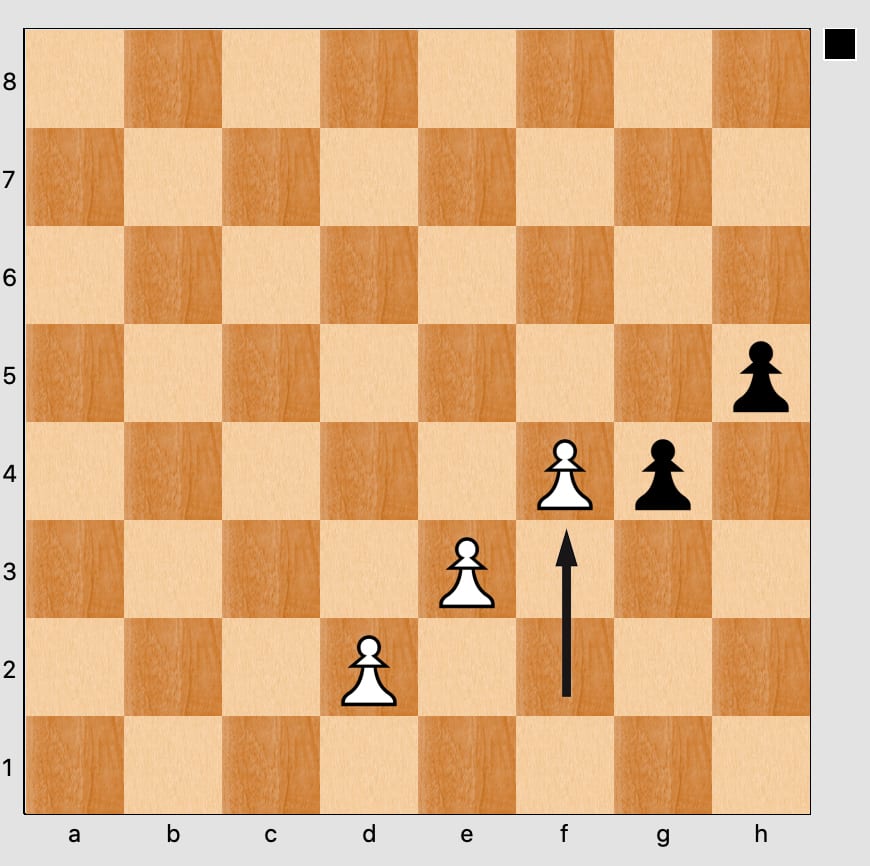
White has just moved a pawn two squares. Can Black take with en passant?
Thirty-five principles
Once the ten opening rules are second nature, here is a longer list to grow into. The last one is the most important.
- Control the centre.
- Develop pieces quickly.
- Knights before bishops.
- Don’t move the same piece twice in the opening.
- Don’t bring your queen out too early.
- Castle before move 10.
- Connect your rooks.
- Rooks should go to open or half-open files.
- Knights on the rim are grim.
- Try to avoid doubled pawns.
- Try to avoid isolated pawns.
- Try to avoid backward pawns.
- Don’t trade a bishop for a knight without a good reason.
- Avoid moving pawns in front of your castled king.
- Don’t open the centre if your king is still there.
- Two minor pieces are usually better than a rook and a pawn.
- Three minor pieces are usually better than a queen.
- Rooks are good on the seventh rank.
- Doubled rooks on an open file are very strong.
- Bishops are better in open positions, knights are better in closed positions.
- The best way to deal with a flank attack is with a counterattack in the centre.
- When two pawns can capture the same piece, capture toward the centre.
- The king should be activated in the endgame.
- Rooks go behind passed pawns.
- Two connected passed pawns on the sixth rank will beat a rook.
- Attack the base of a pawn chain.
- Knights are usually the best piece to use to blockade a pawn.
- If your position is cramped, trading pieces can help.
- Trade your passive pieces for your opponent’s active pieces.
- When ahead in material, trade pieces — not pawns.
- When behind in material, trade pawns — not pieces.
- Games with opposite-coloured bishops are dangerous in the middlegame and drawish in the endgame.
- Don’t play ‘hope’ chess.
- When you see a good move, look for a better move.
- A really good chess player knows the right time to ignore a chess principle.
Next: Chess openings takes the opening ideas further, and Blunders and dangerous squares covers what to do when one of your pieces is attacked.