Chess openings
How to start a game well: control the centre, develop your pieces, get the king safe.
As a chess player you have to know your openings — but not necessarily to any great depth.
Not only is it possible to lose a game in under ten moves (think of Scholar’s Mate), but the moves you make at the start set the course for everything after. You do not want to reach the middlegame carrying a handicap you picked up in the opening, and be stuck with it for the rest of the game.
The good news is that with a little study and practice it is not too difficult to play the first few moves exactly as a grandmaster would — giving away nothing, and reaching the rest of the game equal or better.
The opening tree
Learn the basics of an opening and the “tree” will look like this. Take any opening and learn its first four or five moves.
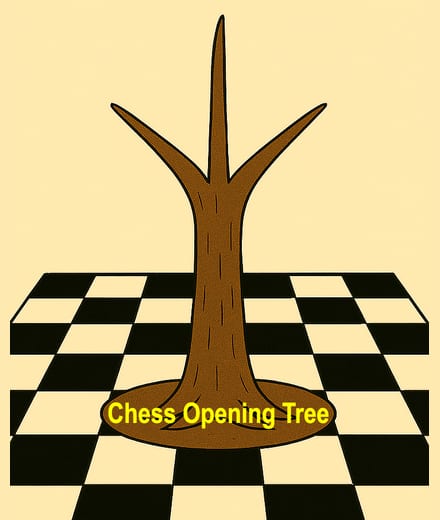
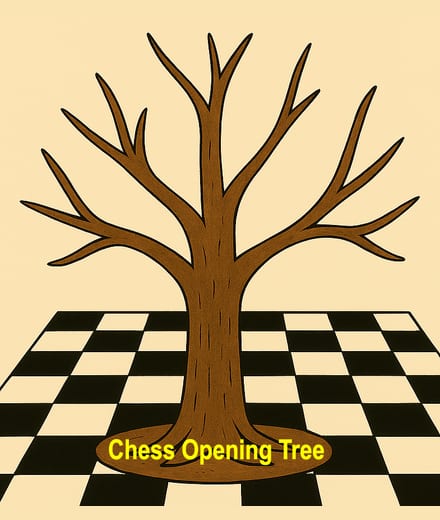
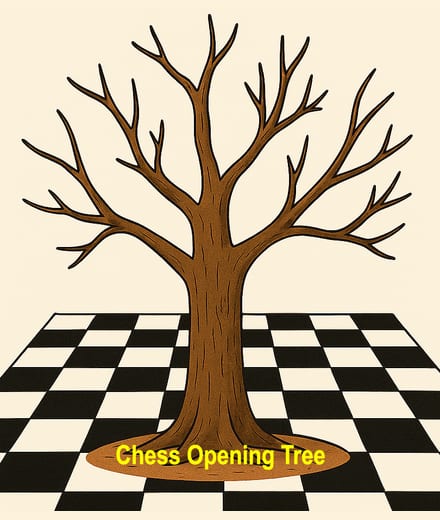
Your next move depends on what your opponent plays, and each reply opens more possibilities. The stages in between are the same picture with the branches multiplying — by the fifth the tree is a thicket.
Take an e4 opening followed by Nf3 and Bc4, controlling the centre. That looks like this:
You might find that developing your pieces thoughtfully works better than launching an immediate attack such as the Fried Liver. Castling early is good.
As the game goes on, more options and ideas — more branches — come to mind, and the game grows more complicated. At beginner level this quickly becomes far too much to learn or take in. That is the moment to lean on the tactics instead: pins, forks, skewers, discovered attacks, checks and, of course, checkmate.
The advice: do not waste time memorising every possible line in an opening. Learn the first few moves of the openings you choose, and really understand the ideas behind them.
Popular chess openings
These are the openings the club looks at most often:
- Evans Gambit
- French Defence
- Giuoco Piano
- London Opening
- Owen’s Defence
- Queen’s Gambit
- Ruy Lopez
- Sicilian Defence
- Stonewall Attack
Each one links through to opening lines, where you can play the moves through. And if something there does not make sense, ask at a Saturday session — that is what the coaches are there for.