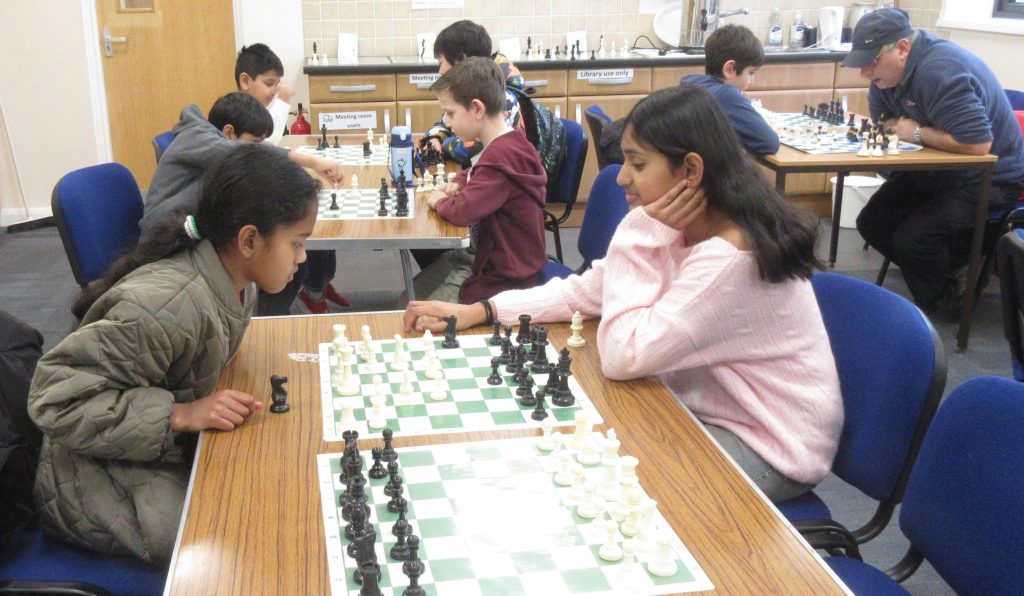
18 juniors came along today, bravely facing the rainy weather and thoroughly enjoying a fun and engaging session of chess. Despite the damp conditions, their enthusiasm for the game was evident as they gathered to play and learn together. Unfortunately I forgot to take photos during the first session, far too busy!
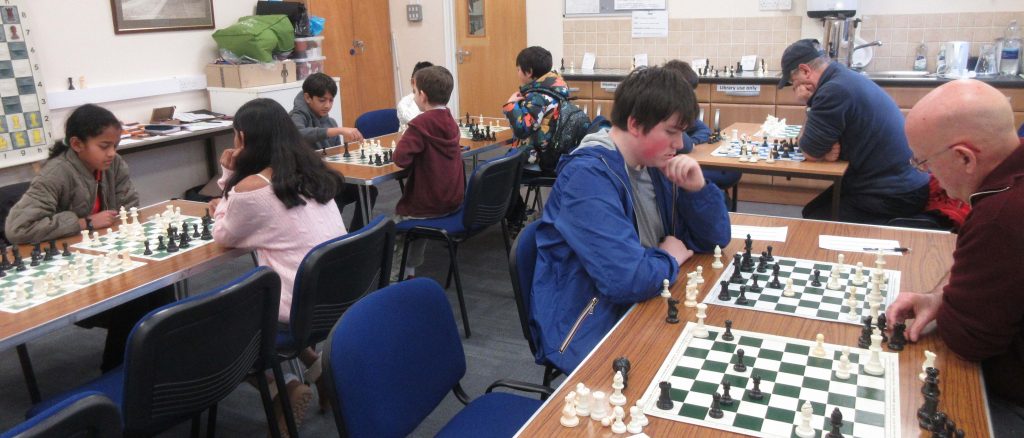
A warm welcome to our new and experienced 15-year-old player Jack, who, together with Kieran, faced some truly challenging and exciting games against our regular expert Jon, who I again thank for his time.
The theme for the intermediate level was Notation, which might not sound very exciting at first glance, but it is absolutely essential for anyone looking to properly record their games. Understanding notation is a fundamental skill that players need to master in order to track moves accurately and analyze their gameplay in detail. Without this knowledge, it becomes difficult to review past games or share them with others for improvement.
My sincere thanks also extend to Steve Bailey, who graciously paid us a special guest appearance and generously spent his valuable and much appreciated time with young Jack, who is just 6 years old.
Recap on Notation
RECORDING A CHESS GAME
One of the most important things to do if you want to become a stronger player is to record your chess games and analyse them. The way that we do this is called Algebraic Notation. It is very simple and used by chess players all over the world.
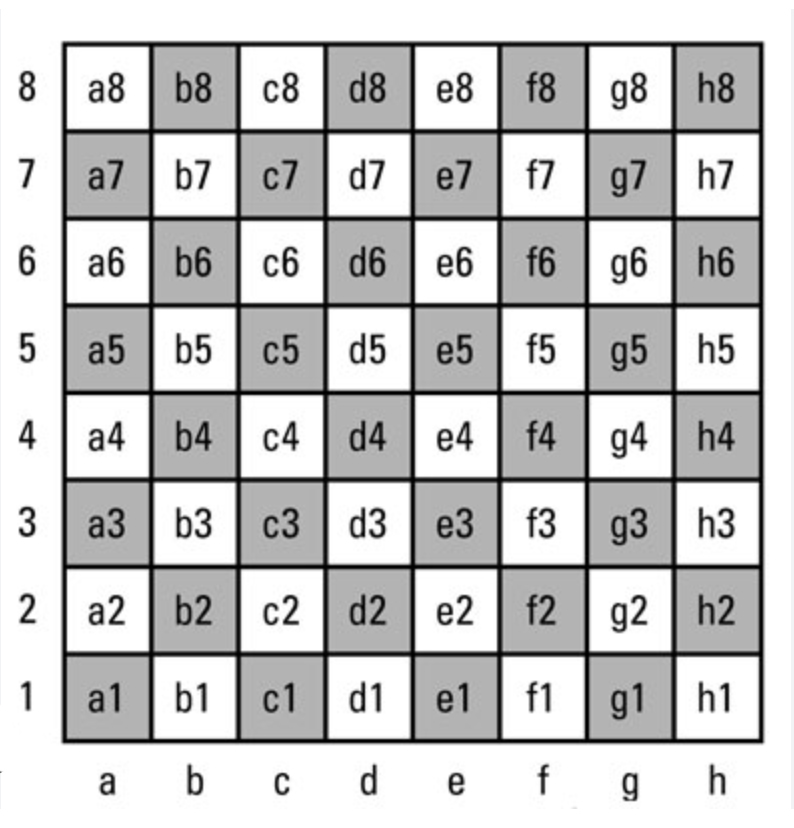
Each of the 64 squares has a unique label of a letter and number as shown in the diagram below. At the start, White’s pieces are on ranks 1 and 2 and Black’s on 7 and 8.
A pawn is given no symbol but the pieces have symbols as follows:
- King = K
- Queen = Q
- Rook = R
- Bishop = B
- Knight = N
We also use symbols for special moves:
- Castling Kingside = 0-0
- Castling Queenside = 0-0-0
- Check = +
- Double Check = ++
- Checkmate = #
- en passant = e.p.
- Captures = x
We indicate a move by giving:
- The move number in the game
- The symbol of the piece
- The square it moves from (if it isn’t obvious)
- The square it moves to
- If it captures a piece, we put an x before the final square coordinates
The art of playing good Chess is to study the board, consider options, devise strategy and anticipate your opponent’s next move(s). This cannot be done in a nanosecond, which is how most youngsters seem to play, ending up in quickly losing material and consequently the game.
In an attempt to try and slow some of you down and take you to the next level in Chess, we need to teach you how to record your game, using notation.
Should you enter a competition, other than Blitz or Rapidplay (short timings) you will be required to record your game this way.
Notation sheets and pens, will be available for those who want to give this a try, we recommend all advanced players in our groups to learn this.
Chess notation was developed in order to record the position of the pieces on the Chessboard or the moves being made during a Chess game. This done by indicating the current piece and square location and where the piece is being moved to. It also enables us to review Chess games played by not only Grandmasters and other Chess players but also your own games, allowing you to go back over your own games and learn from them. Learning Chess notation is a must to study Chess games and problems from any kind of Chess book.
With so many students here today a lot of games were played, some were Ladder games, one was for the Mountain Challenge, the rest just for fun.
Winners today include:-Monty, Zayd, Chester, Oscar, Jack15, Kieran, Gagan, Wyatt and Eden.
Draws for Michal, Wyatt, Toshika, Tishi, Eden and Gagan.
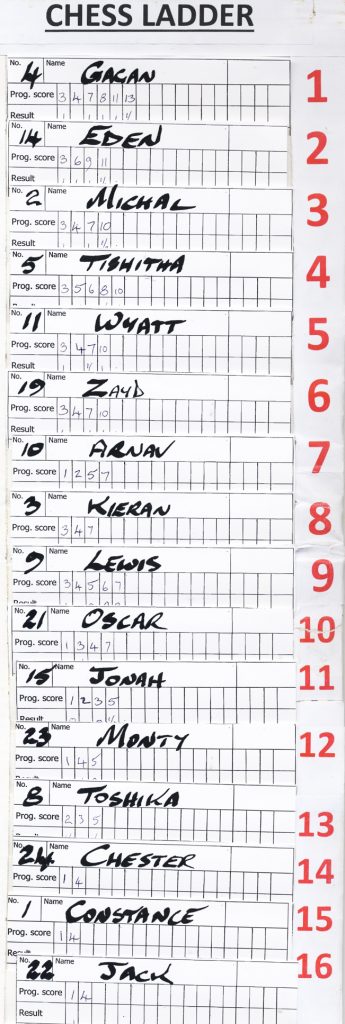
Ladder shake-up, top 16 now looks like this,(those on equal points are in alphabetical order.)
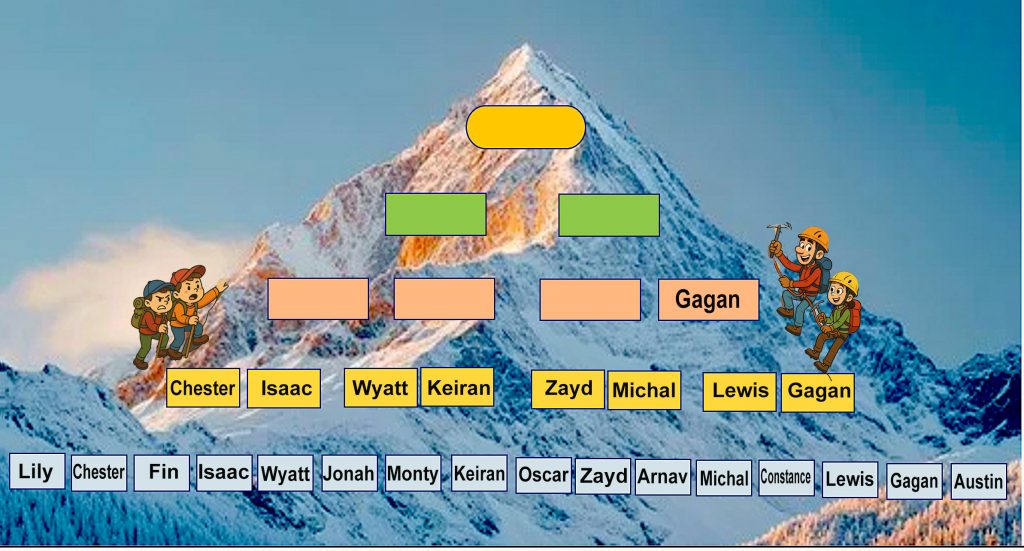
Mountain Challenge Latest
Just the one match played today - Lewis v Gagan - a win for Gagan means he climbs to the 3rd level.
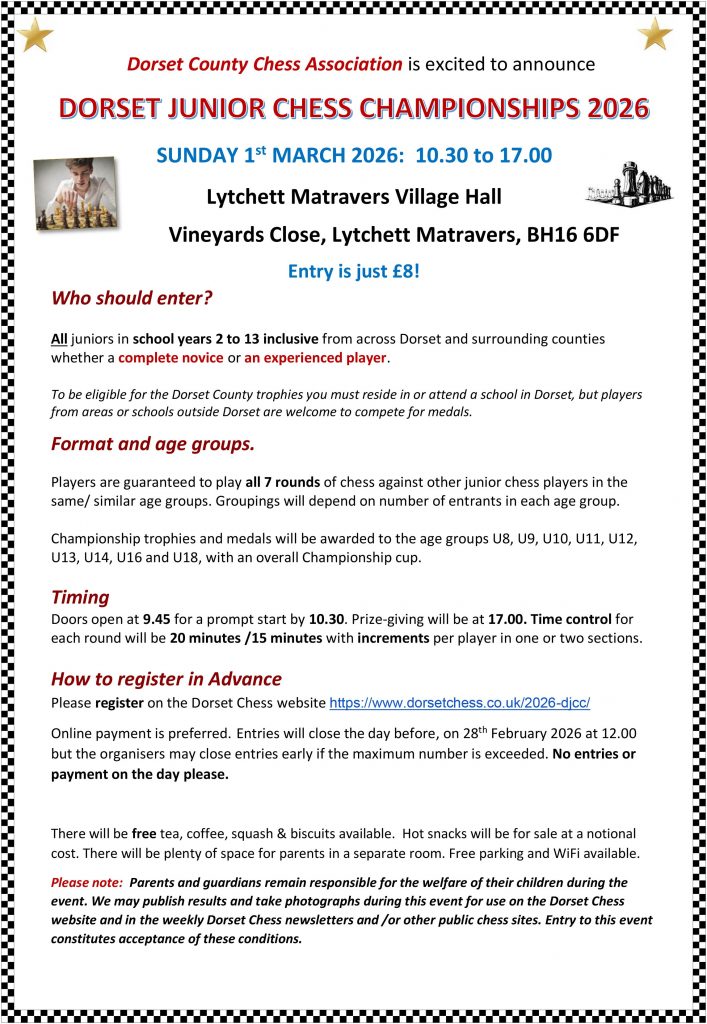
Junior Competition
Hope to see you all next week
